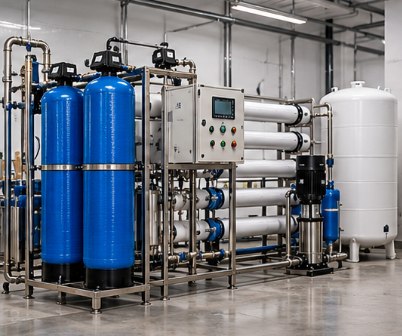
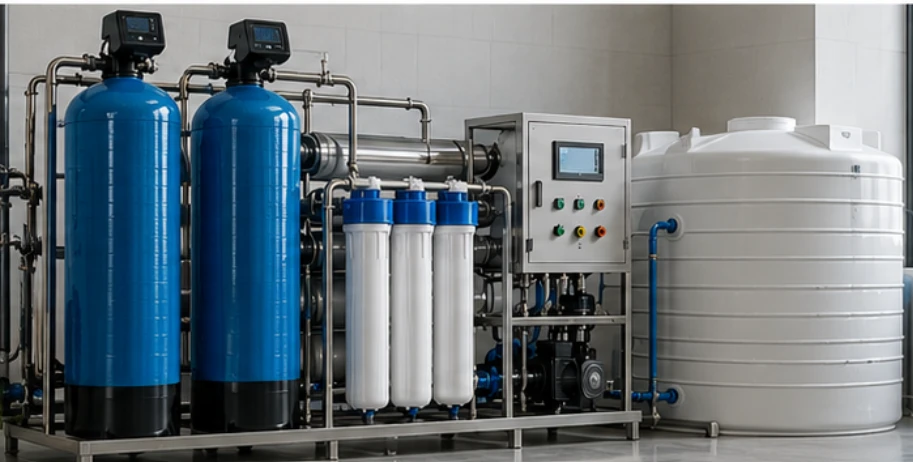
A commercial RO plant is a working machine that runs for hours every day. Without regular care, membranes foul, output drops, TDS rises and the plant eventually stops. A planned RO plant service routine keeps water quality steady and protects the most expensive parts. Here is a practical schedule.
Daily checks (5 to 10 minutes)
- Record input and output TDS.
- Record feed, reject and product flow rates.
- Check pressure gauges before and after the cartridge filters and across the membranes.
- Look for leaks, unusual noise or vibration.
- Check antiscalant or other chemical dosing tank levels.
- Confirm the product water tank level and UV lamp status.
Weekly tasks
- Backwash multimedia and carbon filters (or confirm auto backwash ran).
- Check softener salt level and regeneration, if fitted.
- Inspect cartridge filters; replace if pressure drop is high.
- Clean dispensing points and drip areas.
Monthly tasks
- Professional inspection of pump, motor, valves and electricals.
- Calibrate TDS or conductivity meters.
- Review the log for trends in flow, pressure and TDS.
- Clean and sanitise product water tanks as scheduled.
Membrane cleaning (CIP)
Membranes foul gradually with scale, organic matter and biological growth. Clean-in-place (CIP) uses specific chemical solutions to restore performance. Signs it is time:
- Normalised product flow drops by around 10 to 15%.
- Pressure difference across the membranes rises by a similar amount.
- Product TDS rises noticeably.
Cleaning early is far more effective than cleaning a badly fouled membrane.
Periodic replacements
| Item | Typical interval |
|---|---|
| Micron cartridge filters | Monthly to quarterly, by pressure drop |
| UV lamp | About once a year |
| Activated carbon media | Every 1 to 2 years, depending on chlorine load |
| Multimedia filter media | Every 2 to 3 years |
| RO membranes | Often 2 to 5 years with good care |
Keep a log
A simple daily log of TDS, flows and pressures is the most useful maintenance tool you have. It shows problems weeks before they cause a breakdown and helps the service technician diagnose faults quickly.
When to call for service immediately
- Product TDS suddenly rises.
- The high-pressure pump trips repeatedly or is noisy.
- Output drops sharply.
- Leaks from pressure vessels or high-pressure lines.
Service contracts for businesses
A commercial AMC with scheduled visits and fixed response times is usually the most reliable approach. Read AMC plans explained, and see our commercial RO service. Choosing a new plant? Start with how to select a commercial RO plant.
Frequently asked questions
How often should a commercial RO plant be serviced?
Most plants need a professional check at least monthly, with daily operator checks in between. Heavily used or industrial plants may need weekly visits.
When does an RO membrane need cleaning?
A common rule is to clean when normalised output drops by about 10 to 15%, pressure difference rises by a similar amount, or product TDS rises noticeably.
How long do commercial RO membranes last?
With good pre-treatment and regular cleaning, often 2 to 5 years. Poor pre-treatment can shorten this to months.
Need help with your purifier?
Share your purifier brand and the problem. We will call back with the next available slot.