Hard water leaves white scale on taps, kettles and shower heads, and makes soap hard to lather. People dealing with it often ask whether they need a water softener, an RO purifier or both. The short answer: they solve different problems. Here is the difference between a water softener vs RO purifier.
What a water softener does
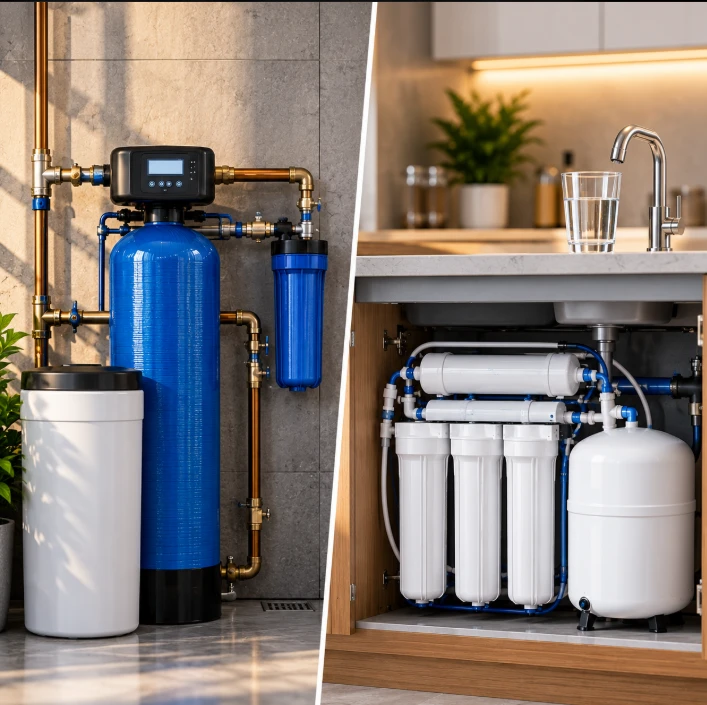
A softener removes hardness, mainly calcium and magnesium, using ion-exchange resin. The resin swaps those hardness minerals for sodium. When the resin is full, it is regenerated with salt brine.
- Removes: hardness (calcium, magnesium), and some softeners also reduce small amounts of iron.
- Does not remove: total dissolved salts, bacteria, viruses or most chemicals.
- Where it goes: on the main line, treating water for the whole home or a bathroom.
What an RO purifier does
An RO purifier forces water through a fine membrane that rejects most dissolved salts, including hardness, and many contaminants. It is usually paired with UV or UF for germs.
- Removes: most dissolved salts (TDS), hardness, many heavy metals and chemicals.
- Where it goes: at the kitchen, for drinking and cooking water only.
- Output: a few litres an hour, not enough for a whole home.
Side-by-side
| Water softener | RO purifier | |
|---|---|---|
| Main purpose | Stop scale, protect pipes and appliances | Safe, good-tasting drinking water |
| Reduces hardness | Yes | Yes |
| Reduces TDS | No | Yes |
| Handles germs | No | Yes, with UV or UF |
| Treats | Whole house or bathroom | Drinking water only |
| Upkeep | Salt for regeneration, periodic service | Filters, membrane, service |
Which do you need?
- Only drinking water tastes salty or heavy: an RO purifier.
- Scale on taps, geysers and tiles, hair and skin feel dry: a water softener.
- Hard, high-TDS borewell water: usually both. A softener for the house, and an RO purifier for drinking.
For borewell supplies, read choosing a purifier for borewell water.
Using both together
When a softener is fitted on the main line, the RO purifier receives softened water. That reduces scaling on the RO membrane and can extend its life. The RO then removes the added sodium and other dissolved salts from your drinking water.
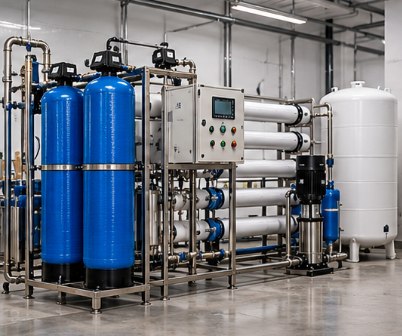
In commercial RO plants, softeners are a common pre-treatment step for the same reason. See selecting a commercial RO plant.
Tell us about your water and we will recommend the right combination.
Frequently asked questions
Is softened water safe to drink?
Softening swaps hardness minerals for a small amount of sodium. For most people it is fine, but it is not purified: it can still contain germs and other dissolved salts. RO is the better choice for drinking water.
Will an RO purifier protect my geyser and bathroom fittings?
No. An RO purifier only treats the small amount of water that goes to its tap. Whole-house protection from scale needs a water softener.
Does a softener help my RO purifier?
Yes. Softened input water reduces scaling on the RO membrane, which can help it last longer in hard-water areas.
Need help with your purifier?
Share your purifier brand and the problem. We will call back with the next available slot.