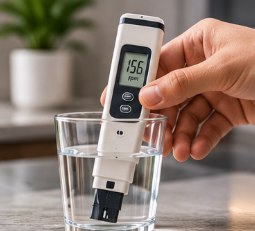
TDS is the number every purifier salesperson and technician talks about. You will see it on purifier boxes, in service reports and on cheap pen-style meters. But what is TDS in water, and how much does that number really tell you about your water's safety? Here is a plain-language explanation.
What TDS means
TDS stands for total dissolved solids: everything dissolved in water that is not water itself. It includes:
- Minerals such as calcium, magnesium, sodium and potassium.
- Salts such as chlorides, sulphates, carbonates and bicarbonates.
- Small amounts of dissolved metals and other substances.
TDS is measured in milligrams per litre (mg/L), which is effectively the same as parts per million (ppm) shown on most meters.
How a TDS meter works
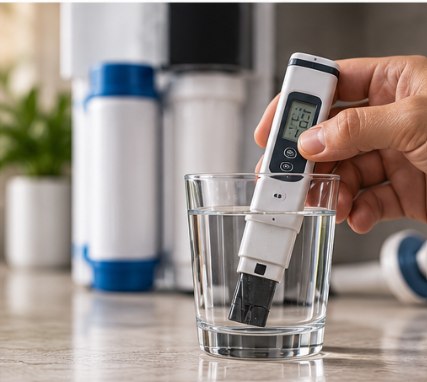
A TDS meter measures how well the water conducts electricity. Dissolved salts carry electrical charge, so more salts mean higher conductivity. The meter converts that into an estimated TDS figure.
To use one: rinse the tip, dip it into a glass of water, wait for the reading to settle and note the number. Test both your tap water and your purifier's output to see how well the RO membrane is working.
What the numbers mean
The Bureau of Indian Standards drinking water specification, IS 10500, sets an acceptable limit of 500 mg/L and a permissible limit of 2000 mg/L where no alternative source is available. As a practical guide:
| TDS (mg/L) | What it usually means |
|---|---|
| Below 50 | Very low; may taste flat. Common after RO without mineral adjustment. |
| 50 to 300 | Good taste for most people. Typical of many municipal supplies. |
| 300 to 500 | Acceptable; taste may be slightly heavier. |
| 500 to 2000 | Above the acceptable limit. RO is recommended. |
| Above 2000 | Not suitable for drinking without RO treatment. |
What a TDS meter cannot tell you
This is the part most people miss. A TDS meter does not detect:
- Bacteria and viruses. These are the most common cause of water-borne illness and do not change TDS.
- Most pesticides and organic chemicals. Many do not conduct electricity.
- Which salts are present. It cannot tell harmless calcium from harmful arsenic, fluoride or nitrate.
- Hardness on its own. Two waters with the same TDS can have very different hardness.
So a low TDS reading does not guarantee safe water, and a TDS reading alone should never be used to sell you a purifier. For borewell water especially, a one-time lab test is worthwhile. See choosing a purifier for borewell water.
How TDS helps you choose and maintain a purifier
- Choosing: high TDS points to RO; low TDS usually means UV + UF is enough. See RO vs UV vs UF.
- Maintaining: if your RO output TDS creeps up over months, the membrane is wearing out.
- Taste: very low TDS explains flat-tasting water. Read why RO water tastes different.
During every RO service, our technicians test input and output TDS and show you the readings.
Frequently asked questions
What is a good TDS level for drinking water?
BIS (IS 10500) sets an acceptable limit of 500 mg/L for drinking water. Many people find water between about 50 and 300 mg/L tastes best. Very low TDS water tastes flat.
Is ppm the same as mg/L?
For drinking water, yes. TDS meters show ppm (parts per million), which is effectively the same as mg/L.
Does low TDS mean my water is safe?
Not necessarily. TDS measures dissolved solids only. Water with low TDS can still contain bacteria, viruses or some chemicals. Disinfection (UV or UF) and good maintenance matter as much as TDS.
Need help with your purifier?
Share your purifier brand and the problem. We will call back with the next available slot.